 Point Forward
Companies don't fail from a lack of software. They fail because leaders still can't see what's broken until it's too late to fix it.
Point Forward is the organizational nervous system — the first system built to show leaders what is breaking before it costs them.
See what's broken.
Fix it in time.
No AI. No predictions. Just what is actually happening (and what to do about it).
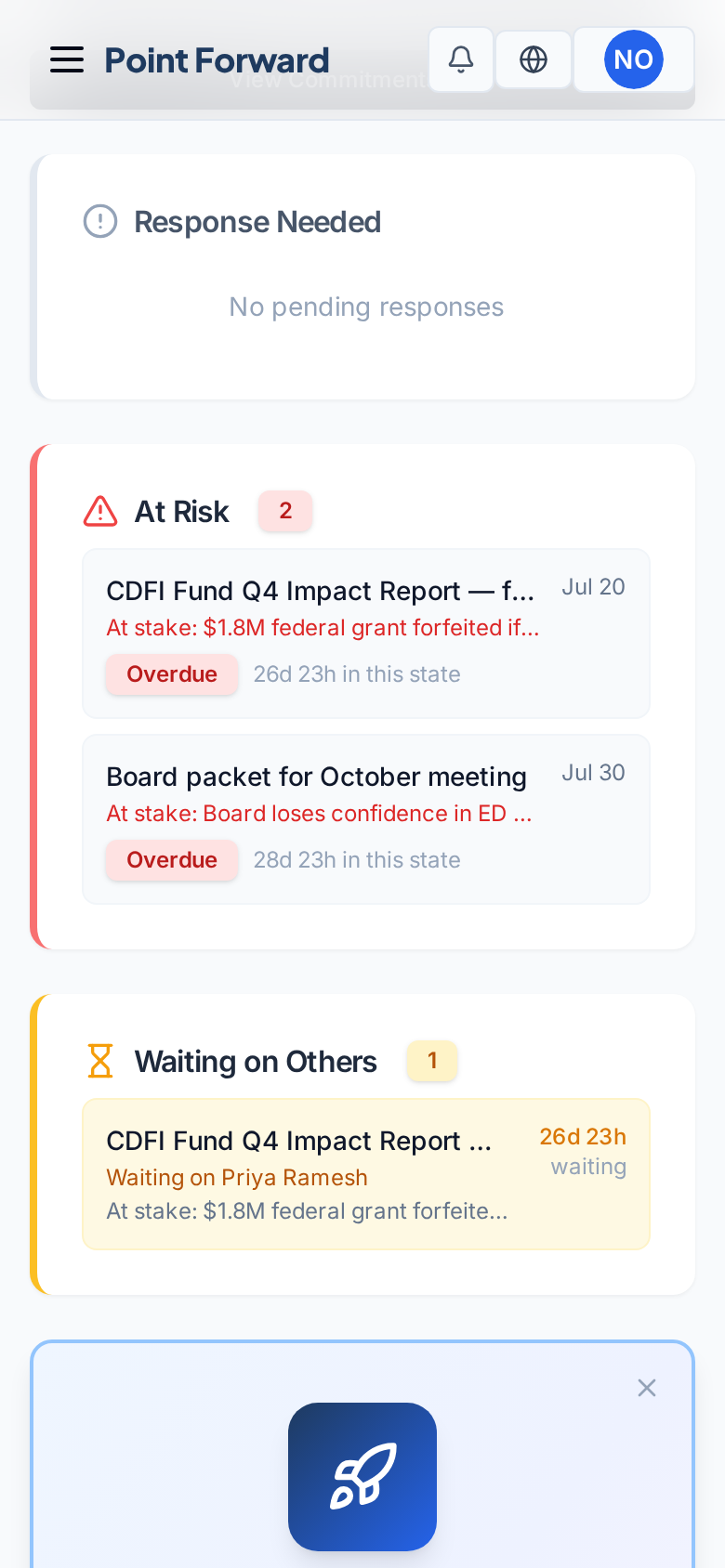
One person, three teams, silence for 11 days (caught before the deadline).
See it for yourself.
Free for 6 months. No card required. Your work history stays with you.
Get Started goes directly to Individual ($180/yr). Team and Enterprise below.
“I finally trust handoffs to stick. Credit and blame travel with the work now.”— Program Manager, Nonprofit Organization
Client logos coming soon — reserved for cleared pilots.
Point Forward is the organizational nervous system.
Tasks and projects describe activity. Point Forward carries signal — from the individual doing the work, through the team depending on it, to the organization accountable for the outcome.
Protect the person doing the work.
Every commitment, every handoff, every dependency — recorded. When something stalls, it is never one person's word against another's. The record protects the individual.
Expose the dependencies between people.
Who is waiting on whom. Who is the single point of failure. Where handoffs pile up. The nervous system shows the wiring status meetings and dashboards routinely miss.
Signal risk before consequences arrive.
At-risk grants. Missed regulatory deadlines. Board commitments that quietly drift. Execution health in real time, plus a permanent, defensible audit trail.
Every commitment is timestamped. Every handoff is recorded. Every override leaves a trace. The result is a defensible record — for the individual, for the team, and for the organization's auditors, funders, and board.
How Point Forward is different.
Project trackers describe what should happen. Point Forward reports what is actually happening — and what is quietly not.
- Tasks
- Projects
- Deadlines
- Status updates
- Activity feeds
- Commitments
- Ownership
- Waiting relationships
- Handoffs
- Blocked work
- Bottlenecks
- Consequences
- Execution risk
- Accountability
| Signal | Project trackers | Status meetings | Point Forward |
|---|---|---|---|
| Who committed to what | Assigned to (task) | Verbal report | Committed to (person, timestamped) |
| Who is waiting on whom | Not tracked | Sometimes surfaced | Explicit dependency graph |
| Silent handoff failures | Invisible | Invisible | Flagged after N days of no motion |
| Single points of failure | Not modeled | Only if someone speaks up | Detected automatically |
| Consequence of the miss | Not captured | Anecdotal | Recorded with the commitment |
| Historical accountability | Overwritten by status changes | Meeting minutes, if any | Immutable audit record |
Point Forward does not replace your tracker or your standups. It sits above them — the layer that turns activity into signal.
Where execution failure creates real consequences.
Not office friction. Real dollars, real reputations, real audits.
Loan closings, covenant deadlines, and grant renewals that quietly slip past a signature-blocked director.
Public commitments, permit turnarounds, and deliverables under freedom-of-information scrutiny.
Board resolutions, regulatory deadlines, and audit-grade documentation of who committed to what, when.
A $1.8M federal grant, one director's inbox, and a deadline no one could see.
A mid-sized community-lending nonprofit was six weeks from a federal grant renewal. Every team said they were on track. Point Forward would have said otherwise.
Status meetings showed green across four teams. Individual dashboards showed steady activity. Nothing in the reporting suggested risk.
Point Forward would have surfaced it: a single Grants Director had three commitments waiting on her sign-off, from three separate teams — with no visible progress for eleven days. The dependency graph made her the invisible single point of failure.
Visible without the ask. A leader could see what her remote teams were actually completing, in real time, without 1:1s, and without having to build the trust required to pull sensitive updates out of people herself. Not another retreat. Not another team-building exercise. The stress wasn't coming from the people, it was coming from a system that made real work invisible.
The pattern is documented in public reporting. Sources below.
Choose your entry point
Start free. Upgrade when you're ready. Your work history stays with you forever.
Who it is for
Built for organizations where execution failure creates meaningful consequences.
Regional
& Global
Deployment
For regional infrastructure, multi-entity governance, and global enterprise (1,000+ users).
Real-time impact verification for regional stakeholders and multi-year systemic risk auditing.
Common questions
Is this another AI tool?
How is this different from Asana, Jira, or Monday?
Do we need to migrate off our current tools?
Is our data private?
Can I try before buying?
We use analytics cookies to understand feature usage. Essentials are always on. Details.